Friday, 2 December 2016

Working Memory Model

Today we looked at the working memory model, probably the trickiest bit of the specification so far.
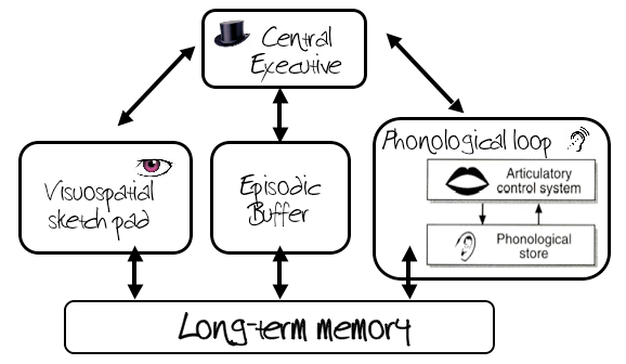
Image result for working memory model

You need to be able to describe the role of each component (we'll do the episodic buffer next week), and use research to support their role if possible. I would recommend the word length study and the folding cubes study for the phonological loop and visuo-spatial sketchpad. 

Friday, 14 October 2016

Encoding and descriptive statistics


Today we looked at how information is stored in the memory. We replicated a study by Baddeley, who concluded that memories are stored acoustically in the short-term store and semantically in the long-term store. Acoustic refers to how things sound (you might remember a shopping list by repeating it to yourself over and over so you can hear it in your head), and semantic refers to the meaning of things (you remember a novel you read last Summer by what happened in it ie it's meaning). The powerpoint on encoding is here.

We also looked at some fairly dry and dusty research methods. We covered methods of central tendency (mean, mode, median) and one measure of dispersion (the range). The ppt is here but this is all well covered in your textbook(s). 

Friday, 23 September 2016

Hypotheses and Capacity

Today we spent some time consolidating our knowledge of hypotheses. All the relevant info is in your textbook and the RM booklet. You need to be able to confidently use the following terms:

- null hypothesis
- alternative hypothesis
- research hypothesis
- experimental hypothesis
- two-tailed hypothesis (non-directional)
- one-tailed hypothesis (directional)

We also traced the history of research into the capacity of our short-term memory. The powerpoint is here and we ended up concluding that it is all probably a bit more complicated than Jacobs thought in 1887. 

Friday, 16 September 2016

Duration of LTM

Image result for sesame street

Today we started discussing LTM and the difference between recognition and recall. It is likely that most long-term memories need some sort of cue or trigger to be recalled. Bahrick et al used memories from high school to test the visual and verbal LTM of 400 participants, and found good evidence for the life-time duration of these memories, thought there was some decline. Interestingly, names were recalled better than faces, and recognition was always better than free recall.

Today's ppt is here. After every lesson (I won't always remind you) you need to find the relevant section in your textbook and the memory booklet and use these resources to annotate your class notes.

We then went on the discuss the nitty gritty of how psychologist 'do' research, ie research methods. This will be a familiar strand throughout your two years of studying Psychology. I handed out booklets (electronic version here) which need to be brought to every lesson. I will source some floppy folders to keep them safe. We discussed aims, hypotheses and variables. The mini-sheet on hypotheses is here.

PLEASE let me know if any of the links don't work, or if you are struggling with the blog in any way. 

Friday, 9 September 2016

The man who keeps falling in love with his wife

Image result for clive wearing


Today we began our study of memory by briefly discussing the fascinating case of Clive Wearing, who has lost most of his long-term memories, and cannot create new ones either. There's lots of information out there (too much? is his privacy being respected?) - but here is an interesting article to start with.

We then got a big technical and tested the duration of our short-term memories, with varying levels of success. The class results were not quite as expected but we had a good discussions as to why this might be.

Today's powerpoint is here.

We also discussed some fairly dry research methods - independent variables and dependent variables. The worksheet is here